Film Study: Halloween (1978)
A Self-Scare Deep Dive into Horror Psychology

The Gestalt Method is a film critique system developed by Jason Stokes (me) at Gestalt Media after extensive research and refinement into the themes and subtext we find in horror media. We do not suggest that the writers, directors, or producers ever intended these concepts (although in some cases, interviews have shown that they are true or partially true). Instead, it indicates that we, as the audience, tend to perceive relatable experiences in fictional stories. Our method makes it simple to identify these using a verifiable, repeatable process that highlights what we believe is the main theme. As always, discussion and commentary are encouraged.
Welcome Home
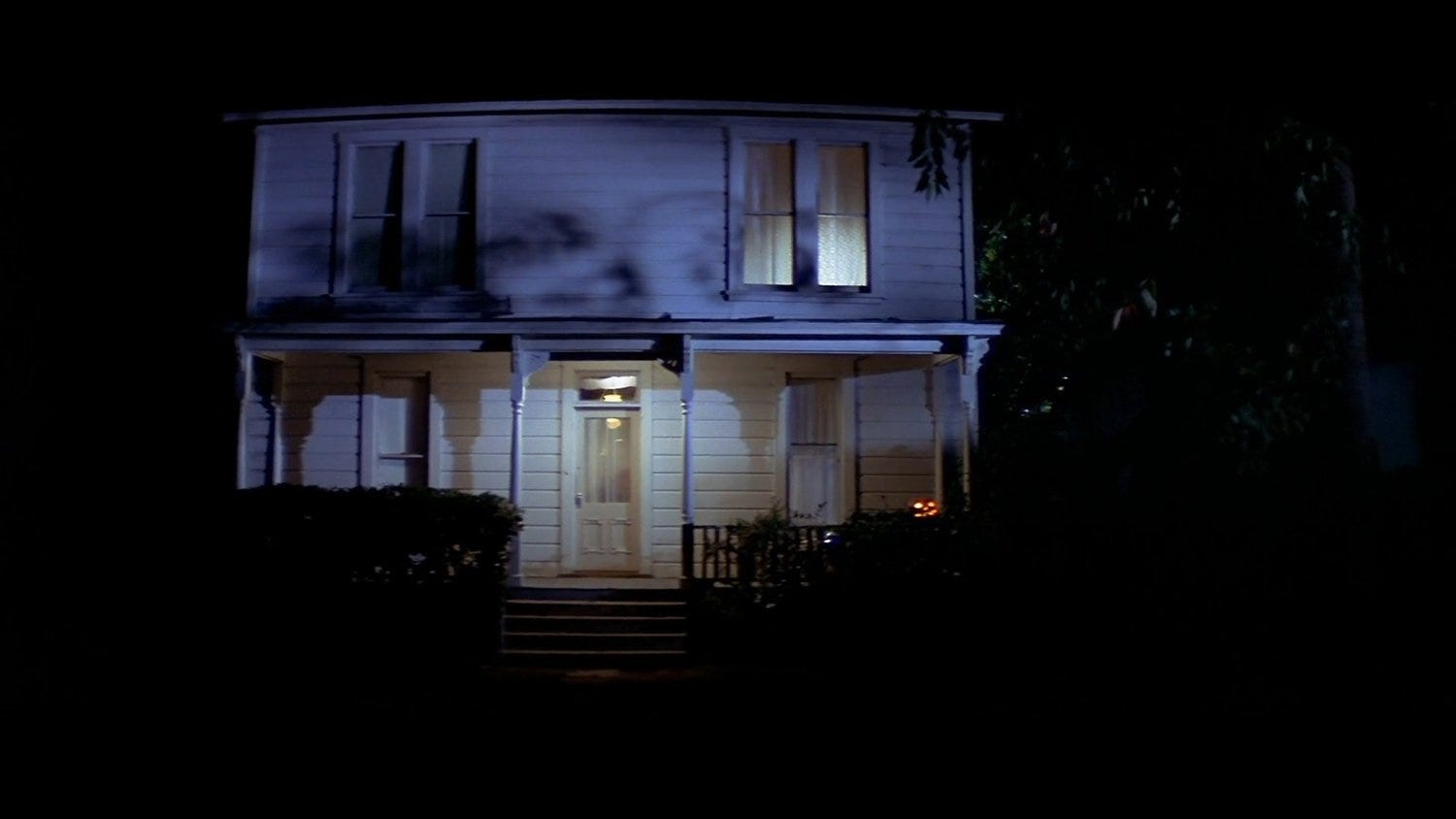
There is no mistake that the theme at the center of Halloween is the home. Specifically, the family inside the home, and later, as events unfold, the deterioration of that symbol of family bliss and security. We begin as an outsider, watching, observing. We are to be detached from this moment, a common psychological element of morality tales. Michael observes the activities of his sister, which are, objectively, for the time, taboo. The family room is now a den of pre-marital sin and promiscuity. It is only minutes (seriously, he was not a good lover - it’s called foreplay, bro) that the sister is dispatched, emotionless. Not a crime of passion but matter of fact. The boyfriend is actually allowed to leave unscathed. This is a story about families, and that’s where the vengeance lies. It’s because of this that the killing comes off more like consequence than an emotional reaction. I think this really sets the tone for the film and subsequently, the series.


When Michael goes outside, standing in the driveway, expressionless and detached, the parents look on in confusion and budding horror. How can this not feel like the beginning of a tale that speaks to the collapse of the modern family unit? Where were the parents? Psychologically, when we deal with kids in horror, we’re very often dealing with a stand-in for ‘future generations’. In this case, Michael feels even more symbolic. The inescapable fate of a culture ignoring its traditions. Not pseudo-religious, social ones like the white family in the white house would suggest, but our deeply held beliefs on caretaking, generational stewardship, and most importantly, social cohesion.
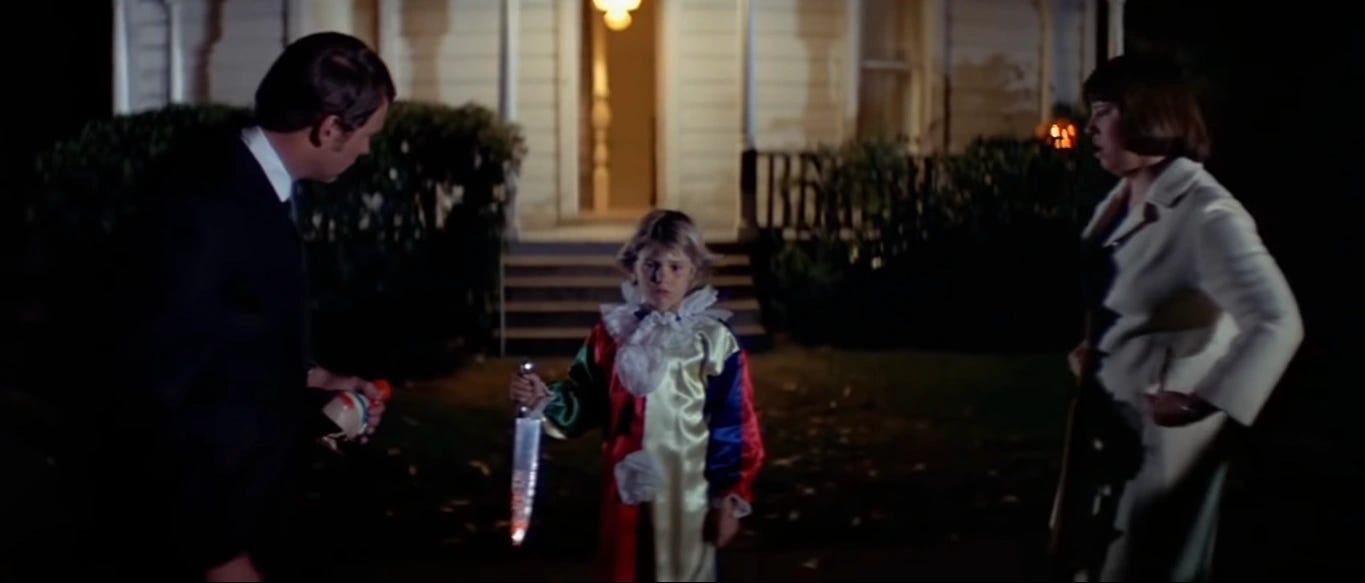
This opening vignette speaks a thousand words on the danger we’re addressing as we go forward.
Social Degradation
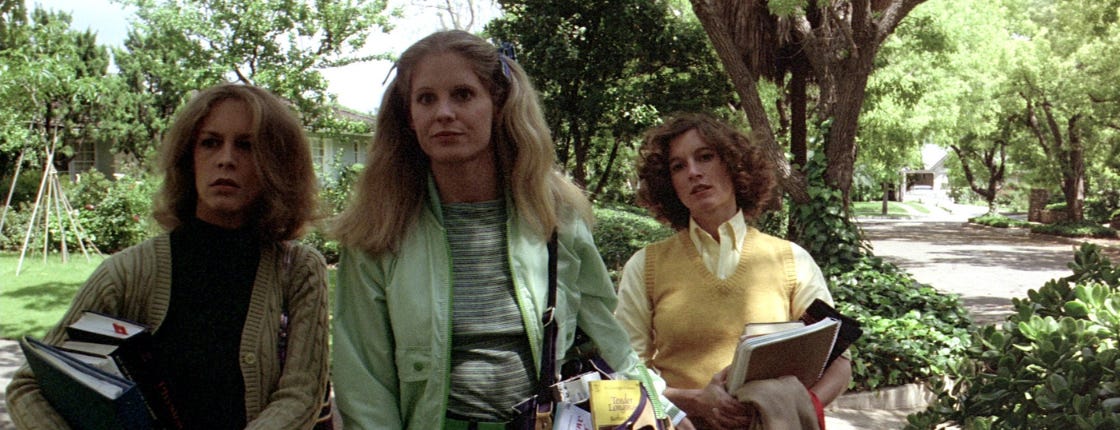
Halloween spends a lot of time on social issues. Even the choice of overt theme directly references tradition (Halloween), the scariest of all social traditions, which consequently also centers around children and telling scary stories as warnings. In this way, Carpenter’s film is a ‘slice of life’ story, pun intended. It is also one of the few films that feels like it gets teenagers right, not as caricatures and exaggerations but as adults, who happen to be younger than 18. Fully formed humans with realistic emotions and developed social lives. Dr. Loomis assumes the role of an older generation, trying to figure out what went wrong and avert a catastrophe. He is our moral compass. The father figure doubles as the police force (or vice versa?). Not a coincidence in my opinion. It suggests the implicit question: Does authority still exist in this world? The kids flaunt their casual subversion of the old rules (smoking pot, having sex) but still keep up pretenses in public. For the most part, Sheriff Brackett is portrayed as well-meaning but ineffective. He is unprepared for this threat.
Fate?
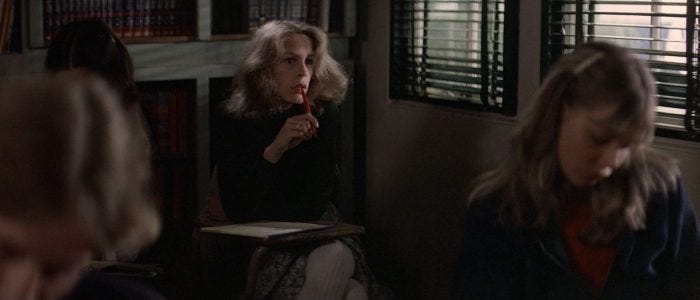
The most unsubtle scene in the film sets a powerful standard. It’s well known that Carpenter intended Myers to be the personification of evil. A force rather than a man, and that comes through, but the classroom scene sets up an even deeper revelation. Because the teacher isn’t talking about evil, she is talking about fate. In a scene where Laurie gazes out the window at Myers, not yet aware who he is, the teacher says:
You see fate caught up with several lives here.
No matter what course of action Collins took…he was destined to his own fate, his own day of reckoning with himself.
The idea...is...that destiny...is a very real, concrete thing that every person has to deal with. How does Samuels’ view of fate differ from that of Costaine’s?
When pressed, Laurie responds:
Costaine wrote that fate was somehow related only to religion, where Samuels felt that...well, fate was like a natural element, like earth, air, fire, and water.
The teacher agrees and continues:
That’s right, Samuels definitely personified fate.
In Samuels’ writing, fate is immovable like a mountain.
It stands, where man passes away.
Fate never changes.
We’re being preached to here. We never see the teacher. The scene chooses to focus on Laurie the entire time. A disembodied voice, delivering a message, not a character engaging in dialogue.
To drive the point home, Myers appears during this discourse, like a mountain, silent and unmoving outside. Here in the very beginning, is the explicit notification to our audience, you are being given a moral lesson, a warning - pay attention! This is a cause-and-effect story that very well can determine your fate.
Of note, the teacher is comparing the authors ‘Samuels’ and ‘Costaine’…holding up the personified evil perspective of Samuels as preferred to the less academic, religious-based views of Costaine via comparison. In this film, the psychologist who treats Michael and serves as the moral authority is…Dr. Samuel Loomis.
Danger Ever Present


Where does Michael appear? He appears at school. He lurks on the way home. He lingers in between the sheets ( a typical sign of domesticity). In short, danger is everywhere. It is never far away and waits around every corner for its opportunity.
Maternal Instincts
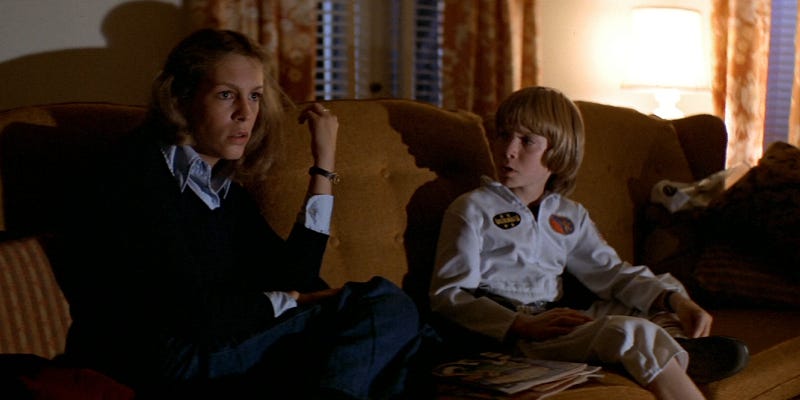
Placing the opening scene in a more idyllic era and fast-forwarding suggests a framework of cause and effect over generations. We’re seeing how what we ignore then becomes what we see now. Nearly the exact same lovemaking scenario is played out in the second act, with Lynda and Tommy (including the exceptionally short performance - wtf guys?) This mirror feels entirely intentional, and is, regardless, a solid touchstone for causality in this cinematic universe.
What is the key difference? Laurie. Our heroine refuses her invitation to the party in favor of taking charge of the children. She is not virginal….so this isn’t a morality tale about the dangers of teenage sex. She smokes weed, so unlike the post-Reagan slashers that co-opt this framework and develop the ethical tale we know from horror, it isn’t about social norms and objective morality. Laurie is two things specifically: maternal, in that she cares about the kids and sees to their safety, assuring them the bogeyman isn’t real and can’t harm them. She is also aware. Vigilance is the virtue that is most prized in Halloween. Being aware of potential danger, rather than blissfully ignorant, becomes the behavior that saves her life.
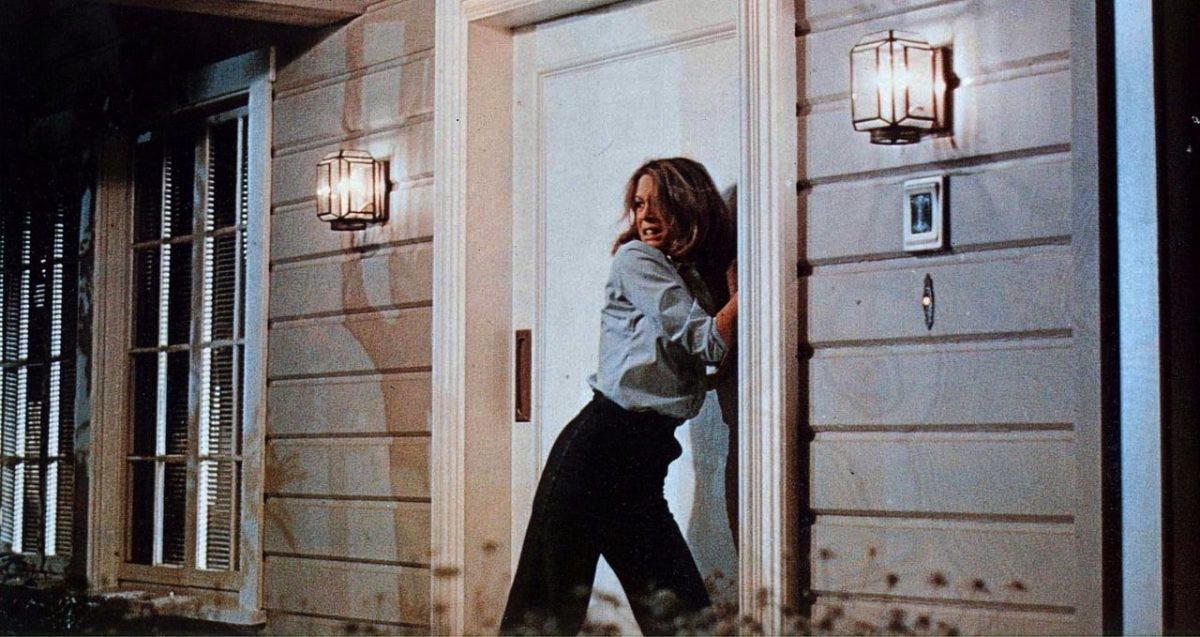
Another exposition fits into the story, that by now clearly revolves around degrading social structures, occurs when Laurie seeks help. She locks up the kids (protective nature) and goes to find out what’s going on. Chased by Michael, she runs screaming to a neighbor, the light comes on, she’s saved…the light goes off. The neighbors ignore her pleas for help. A world where we choose isolation is a dangerous world. Once again, implying an endorsement of social cohesion, or at least condemnation of societal apathy.
It’s ultimately Tommy that saves her life. Her protection of the kids pays off, even if it does provide a scare as the adolescent stumbles even slower than Jason Voorhees down the stairs to open the front door.
The Girl Next Door
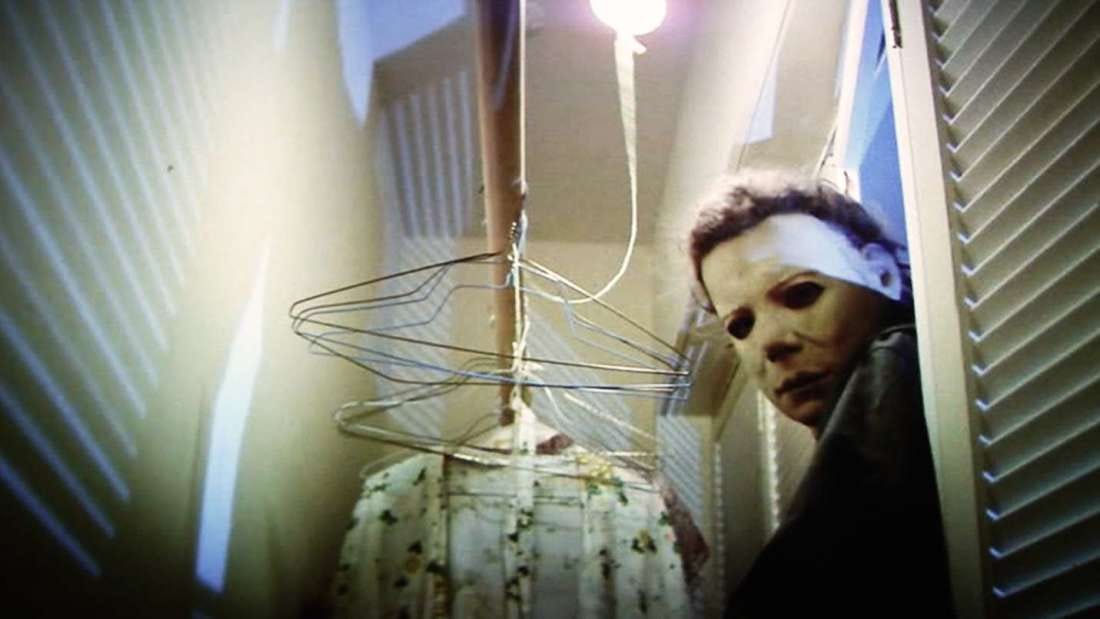
The thing about Laurie that doesn’t appear in slasher films until later entries is her preparedness. Her innate skill and wit. As likable as she is, she is just another girl. In fact, she’s a little bit awkward, obviously not the leader of her friend group, and somewhat shy. As we see in Carol Clover’s dissection of and eventual naming of the ‘Final Girl’, typically this character is self-sufficient, possessing an almost masculine quality in their ability to resolve a situation when presented one. Laurie is terrified; she hides in the closet, she runs to the neighbors. In this first film, she makes no real offensive attacks. She spends the majority of her time protecting the kids and investigating anything that’s unusual. I won’t begin to dissect the use of a coat hanger to save herself from the specter of generational trauma. Let’s call a cigar a cigar in that case.
How to Kill a Monster
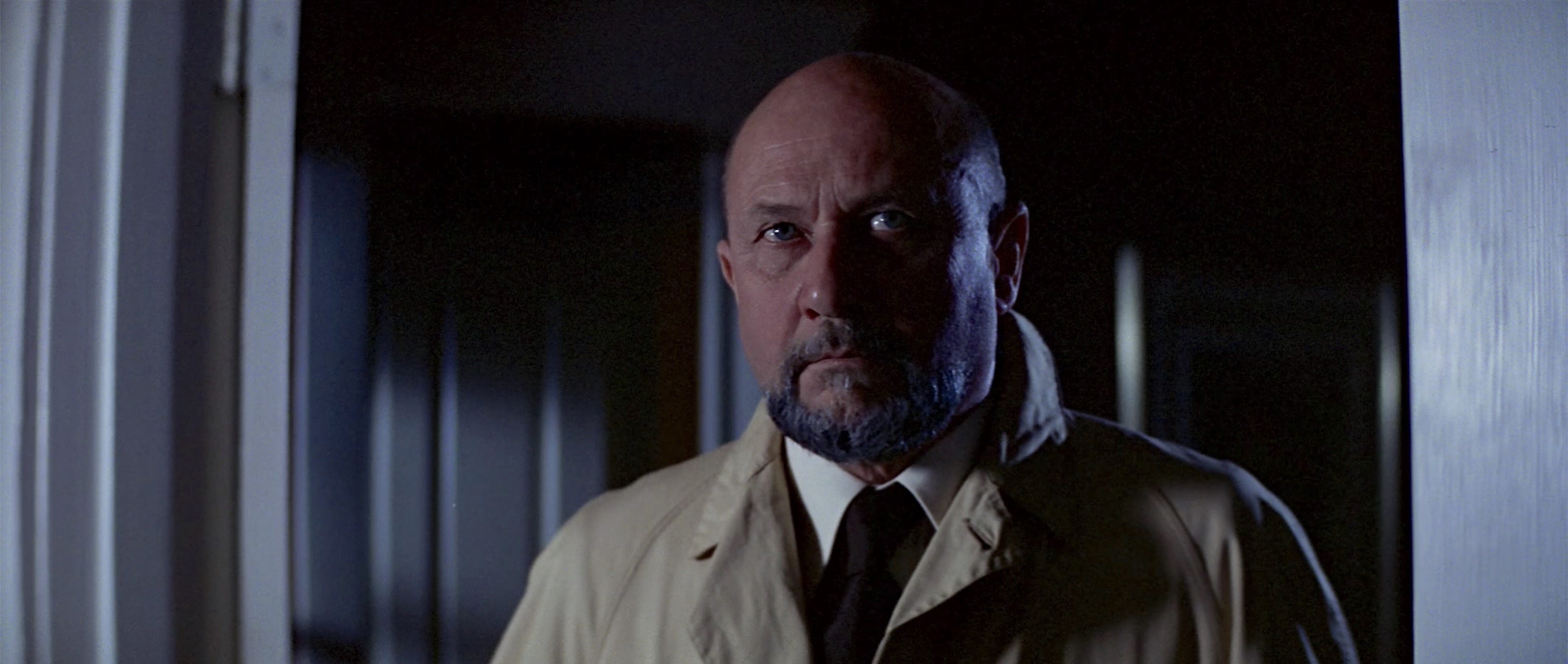
Not only does Dr. Loomis appear to represent the older generation, he also stands in for knowledge and learned experience. He embodies the vigilance and awareness that Laurie is being championed for. In this scenario, Loomis dictates the shots to the police, not the other way around, and this is most telling about the social order that is being normalized here. Experience and intelligence lead the way; authority and law are natural extensions of that. This very clearly aligns with the evolution of human psychology and how we govern ourselves.
The other clear signal that Loomis is the moral standard is that he’s the one who saves Laurie. In this final scenario, we see the real story. Loomis (knowledge, understanding of evil) protects Laurie (Our next generation and their children) from Michael (the evils of the world). Using his hard-earned understanding, Loomis arrives in time to rescue Laurie and the kids. It wasn’t a battle of strength, wits, or prowess…it was merely his presence based on vigilant awareness that won the day.
The Timeless Truth
Though it occurs in a rushed manner, Halloween continues the long-held tradition of delivering one final warning before the credits. When Loomis goes to the window, seeking to confirm his assassination of Michael Myers, there is no body. It’s a classic trope, but one buried in a deep psychological truth that we return to time and again…you can defeat the evil, but only so much that it retreats, offering reprieve. The most basic truth of fear-based storytelling: the villain never really dies because the danger in the world they represent never really goes away. We must be…vigilant. We must stay aware, lest it find us again when we’re not paying attention.
Laurie: “It was the Boogeyman.”
Dr. Loomis: “As a matter of fact, it was.”
As the credits music begins, we see a montage of locations in Haddonfield. The Strode’s, the neighbors, the now ruined ‘home’ of the Myers family…and breathing. Michael is here, waiting. He’s never far. He is eternal.